A shelter is manufactured in one jurisdiction and approved, installed, commissioned and maintained in another. Neither half works alone. This page is the exact boundary between the two, including who is legally responsible when something goes wrong.
SH-00 · REV 1.0Issued 2026-09-20Gates 0 / 7Construction Not authorised
hero-section
SchematicS3 master · not to scale · indicative arrangement only
SH-15·Demo unit
The demonstration unit is the product
Core channel asset
Nobody buys a shelter from a brochure. They buy it after they have stood inside one, closed the door, heard how quiet it gets, and asked the question they were embarrassed to ask on the phone. Everything else in this programme exists to get a buyer into that room.
This is show-home logic, borrowed from residential property because it is the only sales model that has ever worked for a large, unfamiliar, once-in-a-lifetime purchase that the buyer cannot picture. A display unit does four things a brochure cannot: it makes the size real, it makes the quality tangible, it converts an abstract fear into a concrete decision, and it gives the salesperson a reason to ask for a second visit.
It also solves this programme's hardest problem. We are at concept stage with nothing built, which makes every photograph on this site a drawing. A demonstration unit in your territory is the one asset that ends that argument permanently — it is a real thing, on real ground, that a buyer, a building official and an insurer can all walk into.
01
It is also the 72-hour trial
Every tier has to pass an occupied trial before final acceptance — 72 hours for all tiers, and a further 7 days for the master. Your demonstration unit is where that trial happens. One build, two purposes: the commissioning evidence the engineering needs, and the overnight experience the sale needs.
02
Let them stay the night
An overnight stay is the single highest-converting event in this category, and it is also the most honest. A buyer who has spent a night inside understands the ventilation noise, the bunk width and the bathroom reality before they sign — which is exactly when you want them to understand it, not eighteen months later.
03
It is where the drill happens
Hand-crank the fan at full occupancy against a dirty filter. Kill the power and open the door. Walk out through the secondary exit with a stretcher. A buyer who has done those three things does not need a brochure claim — and an agent who has watched a buyer do them knows exactly which objection to answer next.
04
It is your permit rehearsal
The demonstration unit goes through your local approval process first, with us carrying the engineering. Whatever your building official asks, they ask it once, on our unit, before a paying customer is involved — and the answer becomes a template you reuse on every deal after it.
Commercial terms for the demonstration unit
Terms are set per territory and depend on tier, site and freight, so no figure is published here. What is fixed is the structure: HQ carries the engineering package, the factory documentation and the commissioning support; the partner carries the ground, the local approvals and the installation; and the unit is credited back against the partner's first deals on an agreed schedule. Ask for the territory term sheet.
SH-16·Cost logic
Flagship first, then downward
The master tier was designed first, completely, for a buyer who can afford to ask for everything. That was not vanity — it was the only way to get a full engineering definition. Everything sold below it is that definition with modules removed, which is why a smaller shelter can carry flagship engineering at a price a boutique fabricator cannot reach.
Why the flagship had to come first
You cannot subtract from a definition you never wrote. A company that starts with a cheap product has no architecture to derive from, so its next product is a second architecture — and then it is maintaining two.
The hard engineering — contamination control, smoke control, load priority, manual fallback — only shows up when someone asks for all of it. Design it once at the top and the base module inherits the thinking for free.
One module register, one control logic, one naming system, one spare-parts list, one training course, one service regime. Across three tiers.
The flagship is also the reference installation. It is what a due-diligence engineer reads, and what an insurer asks about, even when the buyer is purchasing the base module.
Where the price advantage actually comes from
Contracting-scale material purchasing rather than retail markup on steel, concrete and plant.
Factory fabrication with an existing workforce and existing jigs, instead of a single bay building one unit at a time.
Engineering documentation produced as a habit, because contracting work is audited — so the documentation is not a project cost, it is a by-product.
Design change between units without re-tooling a product line, because the architecture is modular by construction.
And a limit we will state plainly: none of this shortens a permit, replaces a local engineer's stamp, or produces a tested door assembly. Those are bought in your market, at your market's price, and they belong in every quotation you write.
What this does not license you to say
Do not sell on price alone, and do not present a Chinese cost structure as a guarantee of a final number. The only price published anywhere on this site is the S1 concept budget — USD 180,000 target against a USD 200,000 cap — and it is a concept budget that must be re-validated against local shell, door, anchorage, civil works and labour quotations before it reaches a buyer. In several territories it will not survive that re-validation, and the correct response is to reduce the size, never the floor.
S1 concept budget — the only quotable figure on this site
Line
Scope & assumption
USD
Site investigation, permits, structural and MEP design
Flood, foundation, wind, fire and installation review
$15,000
Tested / listed steel shelter shell
18–28 m² concept scale; final price from supplier quotation and listing scope
$42,000
Rated door, vent protection and shell openings
Door, frame, hardware and certified openings — never modified on site
$13,000
Reinforced concrete foundation, anchorage and site works
Ordinary site assumed; abnormal foundations priced separately
Higher if semi-buried; lower for an above-ground scheme
$14,000
Clean air, backup fan and environmental monitoring
Dual purifiers or central filtration, spare cartridges, sensors
$17,000
Electrical, 5–10 kWh storage, emergency lighting
Excludes a large fixed generator
$16,000
Water, sanitation, fire, comms and 72-hour supplies
Packaged water, emergency toilet, extinguisher, weather radio
$9,000
Transport, lifting, installation and acceptance testing
One ordinary haul and one lift assumed
$11,000
Contingency
About 8–10% planned buffer
$15,000
Target total
Reserve held to the cap — do not spend it early
$180,000
If the quote comes back over budget, cut in this order
1. Reduce area and comfort finishes
2. Drop satellite data; keep a weather radio and optional satellite messaging
3. Fewer general outlets, entertainment and non-critical automation
4. Go above ground to avoid excavation, waterproofing and uplift cost
5. Reduce storage capacity — then re-check air-cleaning and comms endurance
Never cut
The rated shell · The rated door assembly · Foundation anchorage · Ventilation · Smoke and CO monitoring · Emergency lighting · Independent professional review
Land, abnormal geotechnical work, large retaining structures, long utility runs, import duty and major site remediation.
SH-17·Configure
Build a specification, not a quotation
No price is produced
Pick a tier, tell it what you are actually worried about, and choose your options. It returns the module list, the claims this configuration explicitly does not make, and the questions that must be answered before a price can exist. Run it with a buyer in front of you — the exclusions are the part that earns the trust.
Step 1 · Tier
The top tier was defined first and completely. Every step down is that engineering with less of it — not a cheaper system built separately.
Step 2 · What you are actually worried about
Tornado & windborne debris
Solvable, and the only hazard here where a tested, listed, correctly anchored assembly does exactly what it says. The rating belongs to the assembly, not to the steel.
Wildfire smoke
A clean-air refuge with filtration sized to the room, continuous particulate and CO monitoring, and no combustion source inside.
Direct wildfire flame immersion
Outside the design basis. This would need a separately engineered and tested envelope against a defined flame and radiant-heat exposure. If this is what you need, this is not the product — and if an evacuation order is issued and the road is open, leave.
Extended utility failure
Layered energy with a manual fallback at every layer, and a published load priority that protects life safety first. Endurance in days is an output of a mass balance, so it stays TBD until that calculation closes.
Earthquake
Seismic anchorage of plant, flexible connections at equipment, joints that accept differential movement, and a post-event checklist. Blast valves do nothing for an earthquake — that is a different physics and a different design.
Flood, storm surge or high groundwater
This is a siting decision before it is a product decision. A below-grade shelter on a flood-prone parcel is a drowning risk, not a refuge. The honest options are an above-grade rated structure, a different part of the site, a different site, or no purchase.
Radiological fallout
Distance, earth cover, concrete, layout and time do the work. Lead is a calculated local addition at weak points, never a blanket, and never a substitute for a source term and a dose target.
Chemical contamination
Gas-phase filtration selected against named substances, with a stated sorbent capacity and breakthrough time. Sorbents are selective and they exhaust — a filter with no named contaminant is an unmeasurable promise.
Biological contamination
Screening, one-way flow, negative-pressure isolation rooms with dedicated exhaust, and a written release process. An isolation room is never described as sterile; it is described by its air change, pressure differential and filtration.
External blast
No claim without a defined pressure–time history as a design input. Blast valves attenuate a pressure wave inside a duct; they are not a structure, a door, or a blast analysis.
Step 3 · Configuration
Envelope & entry
Life support
Contamination control
Fire & situational awareness
Endurance & autonomy
Why a configurator that refuses to quote is better than one that quotes
Every competitor's configurator ends in a number. That number is produced before anyone has seen the ground, and it is the number the buyer remembers and later feels lied to about. Ending in a question list instead does three things: it protects the buyer, it protects you from a quotation you cannot honour, and it moves the conversation to the site visit — which is the only step that actually advances the sale.
SH-18·The sale
The sale, step by step
A show-home sequence, adapted for a product that can legitimately be refused. Note where the disqualification happens: early, cheaply, and before anyone has spent money on a survey.
Step 1
Enquiry and five-minute screen
Before a visit is booked: flood zone, historical high water, basement history, groundwater, drainage, crane access and rescue access. Any one of these can end it, and ending it here costs nobody anything.
Step 2
Visit the demonstration unit
Walk the unit. Close the protective door. Hand-crank the fan. Look at the second exit. Read the claims matrix on the wall — it is printed and framed there for a reason.
Step 3
Configure together
Run the configurator with the buyer, on a screen they can see. Print the specification and the open-questions list, and hand it to them. They leave with a document, not a feeling.
Step 4
Overnight stay, optional but decisive
Offer a night in the unit. The buyers who take it close at a much higher rate, and the ones who decline usually tell you why — which is the objection you actually needed to hear.
Step 5
Paid site survey
The first money that changes hands buys a geotechnical and planning screen, not a shelter. It is credited against the contract, and it is refundable if the site fails — because a site that fails should fail on our conscience, not on their deposit.
Step 6
Engineering, approval, fabrication
Local engineer's stamp, permit, factory acceptance with documentation, freight. The buyer receives the test records, not a promise that tests happened.
Step 7
Install, commission, occupied trial
Site acceptance, integrated test, fault injection, then 72 hours occupied before final handover. People sleep in it before anyone signs it off.
Step 8
Maintenance contract and annual drill
This is where an agent's business stops being a series of one-off deals. Filters, seals, batteries, instrument calibration, a documented annual drill — and a customer you are in the same room with every year, who refers you.
The one number worth tracking
Demonstration-unit visits per month. Everything upstream of it is marketing, everything downstream of it is engineering, and it is the only step in the sequence that an agent fully controls.
SH-20·Why
Why this programme is shaped the way it is
Concept feasibility · G0–G6 not passed
We publish the commercial terms before the product exists, because we would rather lose a partner over an honest timeline than win one on a false one.
Most partner programmes in this category exist to move inventory. Ours cannot: there is no inventory, no chosen site and no chosen jurisdiction. Decision gates G0–G6 are all not passed and construction_authorized = false. What follows is a programme design published at concept-feasibility stage.
It is also a life-safety product whose delivered performance depends as much on the hole in the ground and the anchor bolts as on the steel we ship. Three structural facts follow from that, and they shape every number on these sheets.
80,000USD factory-supplied scope, one S1 unit — EST.Derived from the S1 concept budget: shell 42,000 + door and openings 13,000 + clean air and monitoring 17,000 + energy storage 8,000. Baseline §H.
100,000USD local scope, one S1 unit — EST.Same budget, local lines: 15,000 + 28,000 + 14,000 + 8,000 + 9,000 + 11,000 + 15,000. Baseline §H.
180,000 / 200,000USD S1 concept budget — target / capA concept cost requiring local re-validation. Excludes land, abnormal geotechnics, major retaining works, long utility runs, import duty and major site remediation. Baseline §H.
01
The money is not all in the box
Roughly USD 80,000 of the 180,000 concept budget is factory-supplied scope. Roughly USD 100,000 is local scope — survey, permits, local design, foundation and anchorage, waterproofing, balance of electrical, water, sanitation, comms, supplies, transport, lift, installation, acceptance testing and contingency. A partner who only resells the box is fighting for margin on the smaller half of the job.
02
Compliance is local, and it is personal
FEMA publishes design guidance — FEMA P-320 (6th ed., 2024) and FEMA P-361 (5th ed., 2024) — but FEMA does not certify or verify products. The certification that matters is signed by a licensed design professional and is accepted or rejected by the Authority Having Jurisdiction. That signature cannot be exported from a factory. The partner is therefore not a reseller; the partner holds a local engineering and permitting relationship.
03
The programme has to pay before the product ships
A programme that pays only on delivered units asks a partner to fund a year or more of unpaid market development. Ours pays on gate work — paid site and jurisdiction assessments — from the first month, and it pays for an honest No-Go exactly as it pays for a Go.
Every figure here is a channel-design parameter
Percentages on these sheets are programme design parameters. They are not a quotation and not a price list. The only price anchor we are permitted to publish is the S1 concept budget — USD 180,000 target, USD 200,000 cap — and it is a concept cost, to be re-validated against local suppliers, local labour, local geotechnics and local code.
SH-21·Tiers
Three partner tiers
Functional, not honorific
Each step up buys a defined additional function, and is documented that way — a discount with no functional justification is not a favour, it is a legal exposure.
TIER 1
Referral Partner
Architects, builders, insurance brokers, rural real-estate agents, emergency-management consultants and geotechnical firms — people who meet the customer before we do and do not want to carry delivery risk.
Invests — time only. No fee, no stock, no demonstration, no minimum. The Claims Matrix module and its examination are mandatory.
Gets — a referral fee on qualified, converted introductions; the public asset pack; the Referral Partner badge. No engineering package, no pricing, no trademark use beyond the badge.
Commitment — none. Dormant after 12 months without a qualified introduction.
No exclusivity, everTIER 2
Authorised Dealer
Established design-build contractors, mechanical and electrical contractors with a service department, installers of storm shelters and safe rooms built to ICC 500-2023, and rural construction firms with their own crane and earthworks capability.
Invests — a local entity and insurances; a named, contracted local Registered Design Professional; a builder and installer crew; one technician through HQ certification; a demonstration capability; working capital sufficient to fund a deposit without HQ credit.
Gets — dealer net pricing on factory scope; the full engineering and installation package; CAD and BIM; lead routing inside the territory; co-op accrual; remote commissioning support; an escalation SLA; spares access; and the right to sell paid site and jurisdiction assessments under the HQ methodology.
Commitment — units plus completed paid assessments, because units alone are meaningless before G4. Both are set per territory by the sizing worksheet, reviewed quarterly and enforced annually.
Right of First Look, 12 monthsTIER 3
Master Distributor
Regional distributors of capital equipment or building products already running a branch network, a service fleet and a parts business — organisations that treat aftermarket as a profit centre rather than a cost.
Invests — everything at Tier 2, plus a permanently installed, inspectable demonstration installation; a stocked critical-spares holding; at least two certified technicians; a maintenance-contract business with recurring billing; territory-wide AHJ liaison; the capacity to recruit, train and audit sub-dealers; and a published local claims-governance officer, personally accountable for what is said in the territory.
Gets — master net pricing; the spread on sub-dealer sales; first position in lead routing; a seat on the Partner Technical Council; early access to gate documentation; priority in the demonstration-unit programme; the higher co-op band; and named territory exclusivity once it is earned.
Commitment — a territory-specific annual commitment, sub-dealer recruitment targets, and a maintenance attach-rate floor.
Exclusivity earned, not granted
Exclusivity is granted only when all six are true and audited
01Two technicians hold current HQ certification.
02A permanent demonstration installation exists and has been inspected by HQ.
03At least one project has been delivered in the territory and accepted by an AHJ.
04Maintenance contracts are attached to at least 80% of delivered units.
05The annual commitment has been met for four consecutive quarters.
06Zero unremedied Claims Matrix violations in the preceding 12 months.
Exclusivity converts automatically to non-exclusive Tier 2 on any of
Commitment missed in two consecutive quarters without an agreed cure plan.
A second Claims Matrix violation within 12 months.
Lapse of required insurance, or of technician certification.
An installation performed outside the certified installation manual, or an uncontrolled field modification.
A reportable safety incident attributable to partner workmanship.
Failure of annual sanctions or anti-bribery screening, or a change of control without consent.
Downgrade is the default remedy
We do not sell territories. Selling territory to an unproven partner is how this industry produces abandoned customers with unmaintained life-safety equipment. Termination is reserved for three cases: a prohibited absolute claim, forged or altered test documentation, and a screening failure.
SH-22·Margin
Margin, money, and who pays for what
No build price before G4
Two tracks, because S1 and S2/S3 are commercially different animals: a dealer discount off a published list for S1, and open-book cost-plus with staged gate fees above it.
S1 — a dealer discount off a published list. S1 is a defined, repeatable, factory-configured product. Once G4 (procurement and certification) closes and a list exists, dealers buy factory scope at a fixed discount and price local scope themselves. Simple, auditable, and it lets a dealer quote without calling us.
S2 / S3 — open-book cost-plus with staged gate fees. The baseline states plainly that S3 CAPEX is NOT ESTIMABLE, and S2 has no published budget. Quoting a fixed price against an un-costed scope is how engineering companies go bankrupt and how customers get betrayed. S2 and S3 are sold as a sequence of paid engagements, with supply and build priced open-book, cost-reimbursable plus fee, and no build price quoted before G4.
5%–12%Generator dealer margin off MAP — the outcome we avoidTrade discussion of current dealer terms, down from 25%–30% historically — Mike Holt Forums.
We sit deliberately in the capital-equipment band rather than the generator band: volumes are low, cycles are long, the technical sale is heavy, and we need the channel to fund a real service capability. Referral and finder's fees in industrial capital equipment cluster at 5%–10% of deal value (Magentrix — how manufacturers run distributor channel programmes).
Channel design parameters — not a quotation
Tier
Factory-scope discount off HQ list
Referral fee
Co-op accrual
What the step buys
Referral Partner
n/a
3%–5% of factory-scope net contract value, paid on HQ cash receipt
n/a
Introduction only — no delivery risk, no working capital, no aftercare
Authorised Dealer
22%–30% — 28% standard, 22% floor below minimum commitment, 30% cap at volume
n/a
2% of factory-scope net purchases
Deposit risk, installation liability, warranty first response, technician cost
Each step up buys a defined additional function, recorded in the partner file, and is offered on the same terms to similarly situated partners. We will not grant a discount step for volume alone — in the United States that is Robinson-Patman exposure (SH-27), and in Australia resale price maintenance is a per-se prohibition.
S2 / S3 fee bands — cost-plus
Engineering8%–12% partner coordination fee on HQ-supplied engineering scope.
Supply12%–18% partner fee on factory scope.
Local build15%–25%, set locally by the partner.
Absolute valueNOT ESTIMABLE. S3 CAPEX is not estimable and S2 has no published budget.
Recommended Incoterm: FCA, named place of shipment, Incoterms 2020. The partner is importer of record and controls customs. We will consider DAP for a partner's first unit as a launch concession. We will not trade DDP, and partners should be wary of any supplier in this category who offers it — it means the supplier is guessing at a duty position it cannot control.
This is not lawyerly caution. US Section 232 duties on steel and steel derivatives moved from 25% to 50% in June 2025; over 400 additional product codes were pulled in through the inclusions process in August 2025; and in April 2026 the regime was restructured so that derivative products primarily composed of steel face 50% on full value, while other derivative articles face 15% or 25% where combined steel, aluminium and copper content exceeds 15% of weight, with a reduced 10% rate where at least 95% of that metal content was melted and poured in the US (CBP Section 232 FAQs). We do not yet know which classification applies to our factory scope: the product is not designed, the bill of materials is not frozen, and origin is not fixed.
Who pays what
PartnerInland freight, crane and lift, installation labour and installation liability, import duty and brokerage, local permits.
HQWarranty parts within the warranty period, rework caused by HQ, remote commissioning support, and HQ travel to witness FAT.
Duty sits outside the USD 200,000 cap
The baseline excludes import duty from the cap, so duty either raises the customer price or shrinks the scope. Partners must model it rather than ignore it. Any supplier telling you a landed US cost today is telling you a story.
Payment milestones
Milestone
%
Trigger
Order confirmation and engineering release
20%
Signed order and site data pack received
Long-lead procurement
30%
HQ places certified-component purchase orders
FAT pass and release for shipment
30%
FAT report signed, witness report issued
Delivery to the partner's nominated place
15%
Proof of delivery
Retention
5%
Released on SAT completion and completion of the 72-hour occupancy test
Warranty reserves are required on both sides
HQ retains 2% of factory-scope net for 24 months as a warranty reserve, refundable against a clean record. The partner holds its own reserve of at least 2% of project value against local snagging and first-year service. This is a requirement, not a suggestion: an under-reserved partner defaults to blaming the manufacturer.
SH-23·Worked deal
Worked example — one S1 unit, Authorised Dealer
Illustrative model
A channel-economics model built line by line on the published S1 concept budget — so that a partner can check our arithmetic instead of trusting our enthusiasm.
Read this first
This is an illustrative channel-economics model. It is not a quotation, not a price list, and not a financial performance representation under the FTC Franchise Rule or any equivalent regime. The only anchor is the S1 concept budget — USD 180,000 target, USD 200,000 cap — which is a concept cost to be re-validated with local suppliers, local labour, local geotechnics and local code. No partner should assume these outcomes.
Scope split derived from the S1 concept budget
Line
USD
Scope
Tested / listed steel shell
42,000
Factory
Qualified door, vent protection, openings
13,000
Factory
Clean air, backup fan, environmental monitoring
17,000
Factory
Energy-storage package (part of the electrical line)
Illustrative Authorised Dealer P&L, one S1 unit, at the 28% standard dealer discount
Line
USD
Note
Revenue — factory scope
80,000
—
Revenue — local scope
100,000
—
Total revenue
180,000
Concept value, not a price
Cost — factory scope at dealer net, less 28%
(57,600)
—
Cost — local scope delivered at a 75% cost ratio
(75,000)
Subcontract plus self-perform
Inbound freight, insurance, brokerage
(F) TBD
Route and volume not fixed
Import duty
(D) NOT ESTIMABLE
Classification, origin and BOM not frozen
Partner warranty and snag reserve, 2%
(3,600)
—
Selling cost — assessment to contract
(2,500)
—
Contribution before overhead, F and D
41,300
22.9% of concept project value
Memo — co-op accrual, 2% of factory net
1,152
Restricted to pre-approved marketing
Duty sensitivity on factory net of 57,600 — the whole point of the exercise
If the applicable duty rate were
Duty USD
Contribution after duty USD
0%
0
41,300
10%
5,760
35,540
25%
14,400
26,900
50%
28,800
12,500
If duty pushes the project through the cap
A partner who passes duty through to the customer pushes the project above the 180,000 concept target and possibly through the 200,000 cap. At that point the baseline Go/No-Go rule applies: reduce scale, or move to a smaller prefabricated safe room tested and listed to ICC 500-2023. Do not cost-cut by substituting uncertified doors or reduced anchorage.
This is also why HTS classification, origin determination and Incoterm selection are day 0–30 onboarding tasks with a named owner (SH-26), not something to discover at the port.
S2 gate-fee ladder — the partner is cash-positive long before concrete
Stage
What the partner sells
Partner margin
If the project stops
A — G0 Mission and jurisdiction
Threat definition, occupancy definition, land and subsurface rights, jurisdiction screen. Fixed-fee packaged.
Partner keeps the whole local fee and pays HQ a fixed technical day rate
No exposure — paid on delivery
B — G1 Site and geotechnical
Geotechnical investigation, groundwater, flood and landslide screen, access and rescue review. Pass-through at cost.
10%–15% coordination
No exposure
C — G2 Engineering
Structural, MEP, air, water, thermal, fire and egress calculations, HQ-led. Cost-reimbursable plus fee.
8%–12% coordination
No exposure
D — Supply and build
Factory scope plus local build. Open-book cost-plus; no price before G4.
12%–18% on factory scope, 15%–25% on local build
Full commercial risk
E — Service
Maintenance contract, filter and consumable programme, annual re-verification.
Design assumption: an annuity in the 2%–5% of installed value per year band, to be validated locally
Ongoing obligation
Why we pay for a No-Go
A responsible G0 or G1 output can be: this site is unsuitable. The partner must be paid properly for producing that answer. A channel that earns only on completed builds will quietly stop producing honest No-Go findings — and that is how life-safety products end up in flood zones.
The design rule behind the ladder above: a partner who cannot make an acceptable return on stages A to C should not take an S2 pipeline at all, because stage D may legitimately never happen.
SH-24·Scope
What HQ provides, what the partner provides
Now · At G4 · At G6
Split by honesty rather than by brochure. Now exists today at concept-feasibility stage; At G4 needs procurement and certification closed; At G6 needs a commissioned physical product.
cred-supplychain
diagramThe value chain from raw steel to maintenance, with the HQ / partner boundary drawn on it. Everything to the right of the boundary is the partner's revenue and the partner's liability.
proc-lifting
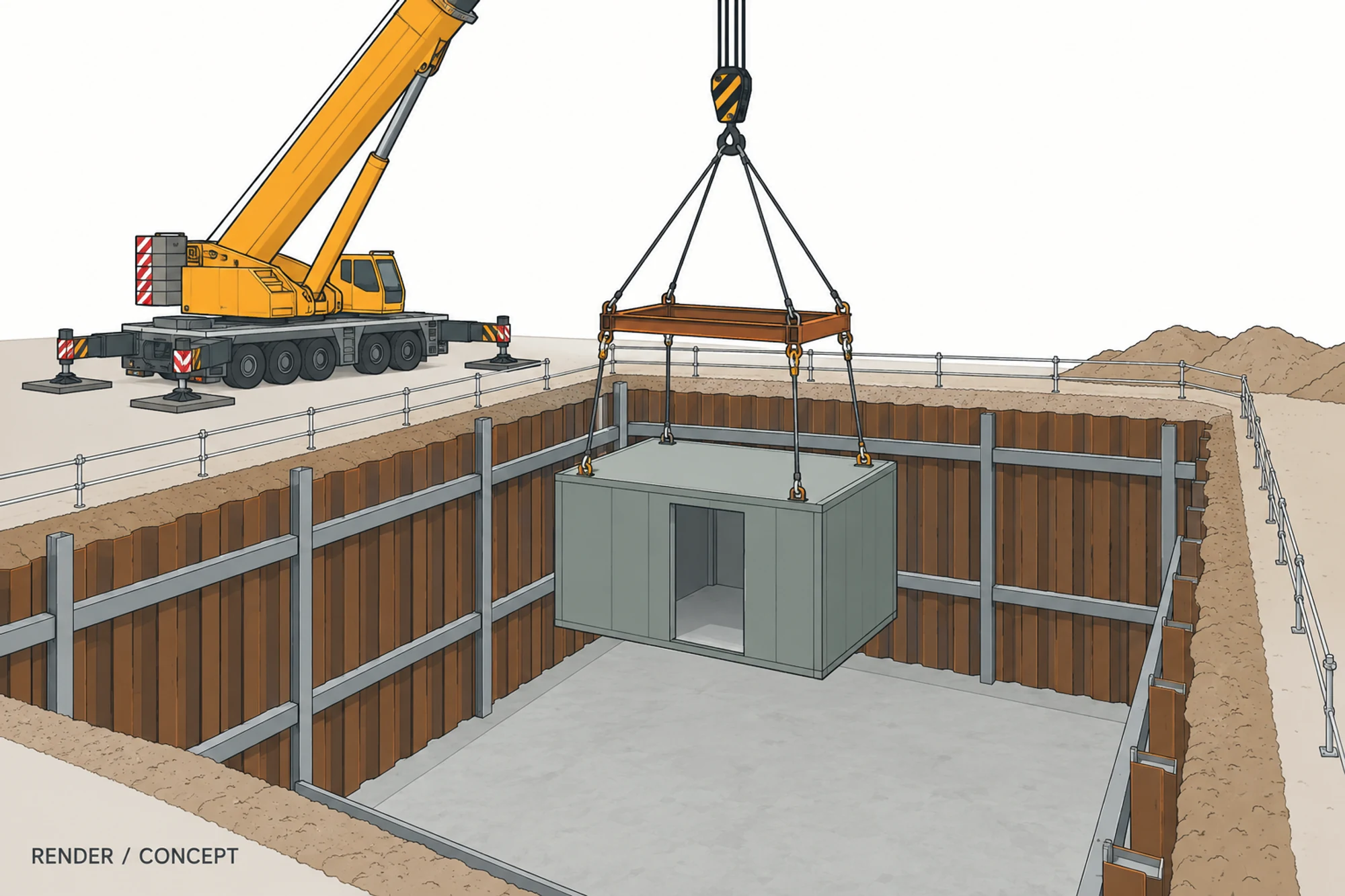
RENDER
renderConcept illustration of module placement. Not a completed installation or a lifting plan; lifting equipment, rigging and site arrangements require a project-specific design and review.AI-generated concept illustration; not a site photograph or test record.
What HQ provides, and honestly when
Provision
Available
Detail
Concept and gate methodology
Now
G0–G6 gate definitions, site screening protocol, threat-matrix template, Go/No-Go criteria
Marketing asset pack
Now
Bilingual and bound to the Claims Matrix: pre-cleared copy blocks, a what-we-do-not-do sheet, a live gate-status page
Claims-matrix training and examination
Now
Mandatory at every tier. Hands-on installation and service certification follows at G4
Lead routing
Now
Territory-based, with a response-time SLA on the partner side (SH-27)
Co-marketing fund
Now — accrues from the first paid assessment
2% Dealer, 3% Master, on factory-scope net. Claim within 12 months; pre-approval and proof of performance required
Demonstration programme
Now in documentation · At G4 in hardware
Pre-G4 a gate-package showroom: air-module mock-up, door / frame / anchorage section, full document set. Post-G4 the first demonstration unit at dealer net less a 10%–15% allowance, with a 24-month resale restriction
Engineering package
At G4
Structural, MEP, air, anchorage load schedules, penetration details, and the 12-layer construction build-up of baseline route A
Module fabrication
At G4
Factory scope per SH-23. Certified components only; no field substitution
CAD and BIM
At G4
Native and IFC, revision-controlled, superseded revisions withdrawn
FAT and commissioning documentation
At G6 — first article
FAT, SAT, single-system commissioning, integrated commissioning, then the 72-hour occupancy test. S3 adds a 7-day occupancy test
Remote commissioning support
At G6
An HQ engineer on call through SAT and the 72-hour occupancy test
Critical spares
At G6
Kit list published; a stocked holding is mandatory for Master Distributors
Escalation SLA
P0 life-safetyAir, egress, the life-safety DC bus. Acknowledge within 1 hour, engineer engaged within 4 hours, 24/7.
P1 majorAcknowledge within 4 business hours, plan within 2 business days.
P2 minorAcknowledge within 2 business days.
In forceCommercial escalation now; technical escalation from G6, when there is hardware to escalate about.
What the partner must provide
Local entityA legal entity in the territory, with verifiable trading history and audited or reviewed financials.
InsurancesCurrent, verified annually, HQ named where appropriate. Full schedule at SH-27.
Design professionalA contracted local Registered Design Professional under a written engagement, not a favour from a friend. In the US licensure is state by state; in Australia registration differs by state — for example the Queensland RPEQ regime and New South Wales design and building practitioner registration. The partner owns this relationship.
Installer crewLicensed, insured, and trained on the certified installation manual. Anchorage and foundation work is where installations of this kind fail.
DemonstrationPre-G4 a documentation showroom with sectional mock-ups; post-G4 real hardware. Master Distributors must hold a permanently installed, inspectable unit.
Service technicianOne trained technician, two for Master Distributors, certification kept current.
Maintenance businessRecurring billing, filter and consumable scheduling, annual re-verification. A partner who cannot invoice recurring revenue will not maintain these systems, and an unmaintained air system is a dangerous object.
AHJ liaisonSomeone who can sit in a pre-application meeting, take a code official's objection seriously, and come back with an engineered answer.
Working capitalSufficient to fund a deposit without HQ credit. Deposits fund certified components.
Customer-data discipline is a condition of appointment
Shelter locations are sensitive. No publishing of customer addresses, no installations-map marketing, and no photographs identifying a site without written consent. Applicable privacy law is observed — US state privacy statutes, and Australia's Privacy Act 1988 as amended. This is a condition of appointment, not a nicety.
SH-25·Compliance
Compliance responsibility split
No compliance claim before AHJ acceptance
The most important sheet in the programme. If a prospective partner disagrees with any row of it, we should not sign.
HQ is legally responsible for
Design of the factory scope, its fabrication, and FAT. HQ is manufacturer of record for factory scope only.
Supplying test evidence for the shell, the door assembly, the openings and the anchorage hardware — and never self-certifying it.
Load schedules, penetration details and interface data, supplied as input to the local design.
The FAT signature, remote commissioning support, and warranty parts within the warranty period.
Formal change control. Without it, no substitution inside a tested assembly is valid.
The partner is legally responsible for
Engaging the local Registered Design Professional and obtaining the site-specific stamp. HQ never signs a local design.
Foundation and anchorage design, to actual site soils and groundwater.
The building permit application and AHJ liaison. HQ supports with documentation; HQ does not apply.
Installation strictly per the certified installation manual: no field modification, no field cutting, no substitution without formal HQ change control.
Executing and signing SAT, and maintenance across the life of the installation.
Everything said in the territory. The partner is legally responsible for its own claims — and may say only what is inside the published Claims Matrix.
Responsibility register — unambiguous by design
Item
Legally responsible
Notes
Design of the factory scope, fabrication, FAT
HQ
Manufacturer of record for factory scope only
Test evidence for shell, door assembly, openings, anchorage hardware
HQ must supply it; HQ does not self-certify
Door, frame, hardware and anchorage are a tested assembly. Substituting any component voids the evidence
Site-specific design and the professional stamp
The local Registered Design Professional engaged by the partner or customer — never HQ
HQ supplies load schedules and interface data as input only
Foundation and anchorage design
Local RDP
Designed to actual site soils and groundwater
Building permit application and AHJ liaison
Partner, or the customer's builder
HQ supports with documentation; HQ does not apply
Installation
Partner
Per certified installation manual. No field modification, no field cutting, no substitution without formal HQ change control
Commissioning and SAT
Joint, with separate signatures
HQ signs FAT; the partner executes and signs SAT; the AHJ accepts
FEMA publishes guidance. FEMA does not certify products.
FEMA P-320 (6th ed., 2024) and FEMA P-361 (5th ed., 2024) are design guidance. FEMA does not certify, approve or list products. The certification that matters is signed by a registered design professional against the applicable standard, and it is the Authority Having Jurisdiction that accepts or rejects the work. No compliance claim may be made before that acceptance.
Standards are periodically superseded. ICC 500-2023 is the current ANSI-approved edition at the date of writing, but partners must verify the edition actually adopted by their own AHJ, which may lag or lead the latest published edition.
Six bindings carried by every performance claim
The test standard relied on.
Its edition — never the bare standard number.
The laboratory that performed the test.
The specimen configuration actually tested.
The installation condition the result depends on.
The validity period of the evidence.
Claims Matrix — the rules, without exception
Prohibited absolutes.Absolutely safe. Nuke-proof. Survives a direct nuclear strike. 100% radiation proof. Filters all toxic gases. Filters everything. Groundwater is naturally safe. Sterile room. And any other unverifiable absolute, in any language.
Restricted names. Tornado safe room, civil defence works, CBRN bunker and ballistic door may appear only when bound to a named test standard, its edition, and a design basis that actually applies to the specimen sold — for example ICC 500-2023 with FEMA P-361 (5th ed., 2024).
No FEMA implication. Never imply FEMA certification, FEMA approval or FEMA listing.
No invented numbers. Burial depth, steel or concrete thickness, lead thickness, door pressure or ballistic rating, ventilation flow, filter capacity, oxygen quantity, water storage, diesel inventory, well depth, safe occupant count or duration. Write TBD or by site calculation.
Prices. Only the S1 concept budget — USD 180,000 target, USD 200,000 cap — always labelled a concept budget requiring local re-validation. S3 CAPEX is NOT ESTIMABLE.
Never dress a de-specified basic unit up as a complete fortress. The S1 basic product does not promise nuclear blast, explosive shock, biological or chemical warfare, long-term full disconnection, or direct wildfire flame impingement.
Nuke-proof. 100% radiation proof.
Radiation protection begins with distance, earth cover, concrete, layout and time. Lead is calculated for specific source terms and weak points, carries no structural load, and must be fully enclosed on both faces.
Neutron protection generally requires hydrogen-rich or boron-bearing materials combined with concrete — not more lead. No unified millimetre figure is given at concept stage. Baseline §E.
FEMA-certified safe room.
Designed against FEMA P-361 (5th ed., 2024) and ICC 500-2023 criteria. Compliance is certified by a registered design professional and accepted by the Authority Having Jurisdiction.
FEMA publishes guidance and does not certify or list products. A shelter is also generally not exempt from a building permit merely because it is an accessory structure.
Filters all toxic gases.
Particulate and gas-phase filtration selected against a defined threat list. Filter type, capacity and change interval are determined by site calculation, and the unit carries CO2, CO, O2, temperature, humidity and smoke monitoring.
No single filter removes all substances. Gas-phase media capacity is one of the baseline's open red-gap items until the G2 air calculations close.
Turnkey shelter delivered for USD 200,000.
S1 concept budget: USD 180,000 target with a USD 200,000 cap — a concept cost excluding land, abnormal geotechnics, major retaining works, long utility runs, import duty and major site remediation, to be re-validated locally.
The cap is a concept ceiling, not a price. Duty alone can move the answer by tens of thousands of dollars (SH-23), and where local quotations push the necessary life-safety items past the cap, the response is a smaller certified unit — never a cheaper door.
Enforcement
First violationWritten notice, retraction within 5 business days, mandatory retraining within 10.
Second within 12 monthsLead routing and co-op funds suspended; tier downgrade.
Third — or any prohibited absolute, or forged or altered test documentationImmediate termination and public withdrawal of authorisation.
SH-26·Onboarding
Onboarding roadmap, and how territory is drawn
Q3 milestone conditional on HQ gates
Ninety days to a signed appointment and a first paid assessment; twelve months to a scorecard. Territory is measured, never drawn around a state line.
Days 0–30
Qualify and bind
Nothing commercial happens until screening is clear and the Claims Matrix examination is passed.
Mutual NDA.
Sanctions and anti-bribery screening: OFAC SDN, the BIS Entity List, Australia's DFAT Consolidated List, plus ultimate-beneficial-owner identification.
Claims Matrix training and examination — this is a gate. A partner who fails it does not proceed.
A named owner appointed for HTS classification, origin determination and Incoterm strategy.
Executive alignment call covering the honest gate status.
Days 31–60
Build the local compliance spine
This is the month that decides whether the appointment is real, because it is the month the partner meets a code official.
Local Registered Design Professional identified and engaged under a letter of engagement.
Builder and installer shortlist, with licence and insurance verified.
A pre-application meeting held with at least one AHJ in the territory — not to sell, but to learn what will be asked for.
A local code gap report delivered back to HQ. This is a two-way obligation, and it is how our design baseline improves.
Pipeline build begins; co-op plan drafted.
Days 61–90
Commercialise
The appointment is completed by a delivered piece of paid engineering work, not by a signature.
Distribution agreement heads of terms agreed, definitive agreement executed.
Technician nominated for certification. Demonstration plan approved and funded.
First paid site and jurisdiction assessment sold and delivered — paid, never free. Free assessments teach customers that engineering is worthless.
Trademark licence issued with quality-control terms. Lead routing switched on.
Months 4–12
Ramp
Quarterly milestones, ending in a documented scorecard review and a territory and tier decision.
Q1 — accreditation complete, two paid assessments delivered, demonstration plan funded.
Q2 — four to eight paid assessments, AHJ relationships established in at least three jurisdictions, gate-package showroom open, first maintenance-contract template localised.
Q3 — subject to HQ passing G4 — first firm order placed, first installation delivered, AHJ acceptance obtained.
Q4 — maintenance attach rate above 80% on delivered units, annual scorecard review, territory and tier decision.
Honest caveat on the Q3 milestone
The Q3 milestone is conditional on HQ's own gates. We will not contractually commit a partner to a delivery date we cannot control, and we will not accept partner commitments that assume one.
We do not define territories by drawing lines around states. States are administratively convenient and commercially meaningless. A territory is defined by qualified households inside a mapped hazard band, constrained by the number of authorities having jurisdiction inside it. The primary unit is a US county or an Australian Local Government Area, written into the agreement as an explicit postcode list — never a phrase like the West Coast.
Sizing formula — variables, not answers
Qualified households = (owner-occupied detached dwellings within the mapped hazard band) × (share above the income or asset threshold) × (share on land permitting an ancillary structure) − (exclusions)
The hazard band comes from published mapping: for wind, the shelter design wind-speed zones underlying ICC 500-2023 and FEMA P-361 (5th ed., 2024); for bushfire in Australia, state bushfire-prone-area mapping and the AS 3959:2018 bushfire attack levels referenced by the ABCB private bushfire shelter performance standard.
Exclusions apply the baseline's own Go/No-Go rules: sites in flood, landslide, debris-flow or non-rescuable areas are removed from the addressable count rather than sold to anyway.
Territory design constraints
AHJ countDesign target 8–25 distinct authorities per territory. A territory spanning 60 authorities is not a territory; it is a permitting tax.
Measured, not assertedTarget household counts are set per market by the sizing worksheet. We will not publish a household number we have not measured.
ReviewTerritories are reviewed annually and can be re-cut on 12 months' notice.
Security of tenureA partner meeting its commitments cannot have territory taken away mid-term.
SH-27·Scorecard
Scorecard, legal instruments, and who should not apply
Compliance is a gate, not a weighting
A partner who scores well on revenue and badly on compliance is downgraded, not rewarded. We would rather grow slowly than explain a preventable failure to a coroner.
Annual partner scorecard
Domain
Weight
Metrics
Claims and compliance integrity
GATE + 25%
Claims Matrix violations, target 0; documentation completeness of submitted packages; AHJ acceptance rate at first submission; insurance and licence currency
Technical capability
20%
Certified technicians current; RDP engagement active; installation-manual conformance audit score; zero uncontrolled field modifications
Demand generation
20%
Qualified opportunities created; paid assessments delivered; assessment-to-contract conversion; lead response time, target within 1 business day
Delivery and commissioning quality
15%
On-time SAT; snag closure days; 72-hour occupancy test passed at first attempt; rework attributable to the partner
Service annuity
15%
Maintenance attach rate, floor 80%; contract renewal rate; consumable and filter programme compliance; response time to P0 events
Confirm tier · promote · issue a 12-month cure plan · downgrade · terminate.
A partner failing the compliance gate cannot pass the scorecard regardless of revenue.
Every review is documented and evidence-based, and the partner sees the evidence.
01Mutual NDA
IP protection, no reverse engineering, and export-control flow-down to the partner's own personnel and subcontractors.
02Memorandum of understanding
Non-binding on commercial terms; binding on confidentiality, exclusivity of negotiation for a defined window, governing law and dispute forum.
03Distribution agreement — heads of terms
Appointment and tier; territory as a postcode schedule; exclusivity earn and lose mechanics; minimum commitments; pricing and discount schedule; Incoterms with title and risk transfer; payment milestones and retention; warranty and warranty reserve.
The Claims Matrix is incorporated by reference as a binding schedule. Installation-manual conformance and change control; training and certification obligations; the insurance schedule; indemnities split to match the responsibility register at SH-25; limitation of liability with a carve-out for personal injury and death; data protection and customer-site confidentiality.
Term, renewal, downgrade and termination — and post-termination service continuity for installed customers. A partner may not simply walk away from customers with life-safety equipment in the ground.
04Trademark licence
Limited, revocable, quality-controlled and non-sublicensable. No registration of domains or social handles containing the marks. No co-branded claims without written approval.
05Insurance schedule
The widely used commercial baseline is USD 1M per occurrence and USD 2M aggregate, but this is a life-safety product: we require USD/AUD 5M for Authorised Dealers and USD/AUD 10M for Master Distributors including umbrella, with HQ named additional insured and waiver of subrogation, and cover including products-completed operations.
Professional indemnity is carried by the local Registered Design Professional — minimum USD/AUD 2M. The partner does not carry the engineer's risk and must not pretend to. Plus workers' compensation per jurisdiction, installation floater or contract works, and motor. Verified annually, evidence retained.
06Export control and sanctions screening
Every item is classified before shipment. Protective and detection equipment tested and proven effective against chemical or biological agents can fall under ECCN 1A004 on the US Commerce Control List — national-security and anti-terrorism controls, licence required to most destinations — while military-specific items may fall under State Department jurisdiction instead.
Filtration and detection scope is therefore classified item by item and never assumed to be EAR99. Screening against OFAC SDN, the BIS Entity List, the DFAT Consolidated List and equivalents at onboarding, annually, and on any change of control.
The adequate-procedures defence requires controls that are proportionate and genuinely effective — a policy in a drawer does not qualify. Partners accept audit rights, gift and hospitality limits, no facilitation payments, and a whistleblowing channel direct to HQ.
Two structural legal risks we raise ourselves
Franchise law. A trademark licence, plus significant control or assistance, plus a required fee is a franchise under the FTC Franchise Rule regardless of what the contract is called — triggering FDD disclosure at least 14 days before signing or payment, and state registration in many states. Australia's new Franchising Code of Conduct, in force from 1 April 2025 with further changes from 1 November 2025, brings disclosure, information-statement, 14-day consideration and disclosure-register obligations, and has express provisions for dealership arrangements. We will either structure deliberately outside the definition or comply with it properly. We will not pretend the question does not exist.
Pricing law. In the United States, tiered distributor pricing carries Robinson-Patman exposure — dormant for decades, then revived, with the FTC's 2024 action over volume-discount tiers reachable only by the largest buyers still live. Our discount steps are documented as functional discounts tied to defined services and offered on the same terms to similarly situated partners. In Australia, resale price maintenance is a per-se prohibition: HQ may publish a genuinely recommended retail price, but may not require or pressure a partner to sell at or above a minimum, absent an ACCC notification.
Who should not apply — we would rather say this now than in year two
Anyone who wants an exclusive territory at signature. It is not for sale. It is earned (SH-21).
Anyone who needs a price list this quarter. We are at concept feasibility and G0–G6 are not passed. The only publishable anchor is the S1 concept budget, and it is a cost concept, not a price.
Fear marketers. If the plan is countdown timers, collapse narratives and buy-before-it-is-too-late, we are the wrong supplier. Our differentiator is publishing what we cannot do.
Anyone who wants to bury a shipping container. The baseline is explicit: transport containers are not treated as underground load-bearing structures, and a thin steel box directly covered with soil is not the S3 approach.
Anyone who wants to sell absolute protection claims. Radiation protection begins with distance, earth cover, concrete, layout and time; lead is calculated for specific source terms and weak points and carries no structural load. If that nuance is a sales obstacle for you, it is a disqualifier for us.
Anyone unwilling to take permitting responsibility, or who expects HQ to sign a local design. A shelter is generally not automatically exempt from a building permit just because it is an accessory structure.
Anyone who will not run a maintenance business. An unmaintained air system is worse than no system, because the customer believes they are protected.
Anyone expecting HQ financing, consignment stock or unsecured credit. Deposits fund certified components.
Anyone who wants to white-label and conceal the manufacturer. Traceability of a tested assembly is the product.
Anyone who cannot pass sanctions or anti-bribery screening, or who declines audit rights.
Anyone operating where the product may be prohibited or unpermittable who intends to sell anyway.
Anyone whose first question is margin and whose tenth question is still not about the AHJ.
How to apply
Send: legal entity details and ownership structure; three years of trading evidence; current insurance certificates; the name of the licensed engineer you would engage; a description of your install crew and lifting capability; your proposed territory as a postcode list; and one page on the last regulated life-safety product you delivered.
We will respond with the Claims Matrix, the gate-status pack and a screening request. We will not send a price list, because there isn't one yet — and we will say so in writing.
SH-60·Exports
Take it into the room
Pick the sections you need and export them as a slide deck or a PDF. The deck is generated from this page, so a deck can never quietly say something the site does not.